When I started programming professionally, writing code meant constant context switching. You wrote something, hit an error, searched documentation, opened five browser tabs, read Stack Overflow threads, came back, tried again.
Today, you can write a comment like:
// create a debounce function in JavaScript
And within seconds, working code appears.
That shift is not just convenience. It represents a fundamental change in how software is built. This new companion is called a coding assistant and it's quietly becoming one of the most important tools in a developer’s workflow.
In this guide, we’ll walk from beginner understanding to advanced technical depth. By the end, you’ll not only know what a coding assistant is, you’ll know how to use it effectively and responsibly.
What is a Coding Assistant?
At its simplest, a coding assistant is a software tool designed to help developers write, debug and optimize code more efficiently. It acts as an intermediary between the user and a powerful Language Model.
At a basic level, it predicts what you might type next. At an advanced level, it can generate entire functions, refactor code, write test cases, explain complex logic and even help with architectural decisions.
Unlike a raw language model (A language model (LM) is an AI system that learns how human language works so it can understand, generate and predict text.) running on its own which often lacks the ability to read your local files or interact with your system, a coding assistant is equipped with the "hooks" necessary to understand your specific environment. While you are the captain steering the ship, the assistant handles the manual labor: gathering context, suggesting routes and even spotting technical leaks before they become critical errors.
Modern coding assistants are often referred to as:
AI coding tools
AI programming assistants
AI code generation systems
But underneath all those labels, the core idea is simple: It’s a system that understands programming context and helps you think and build faster.
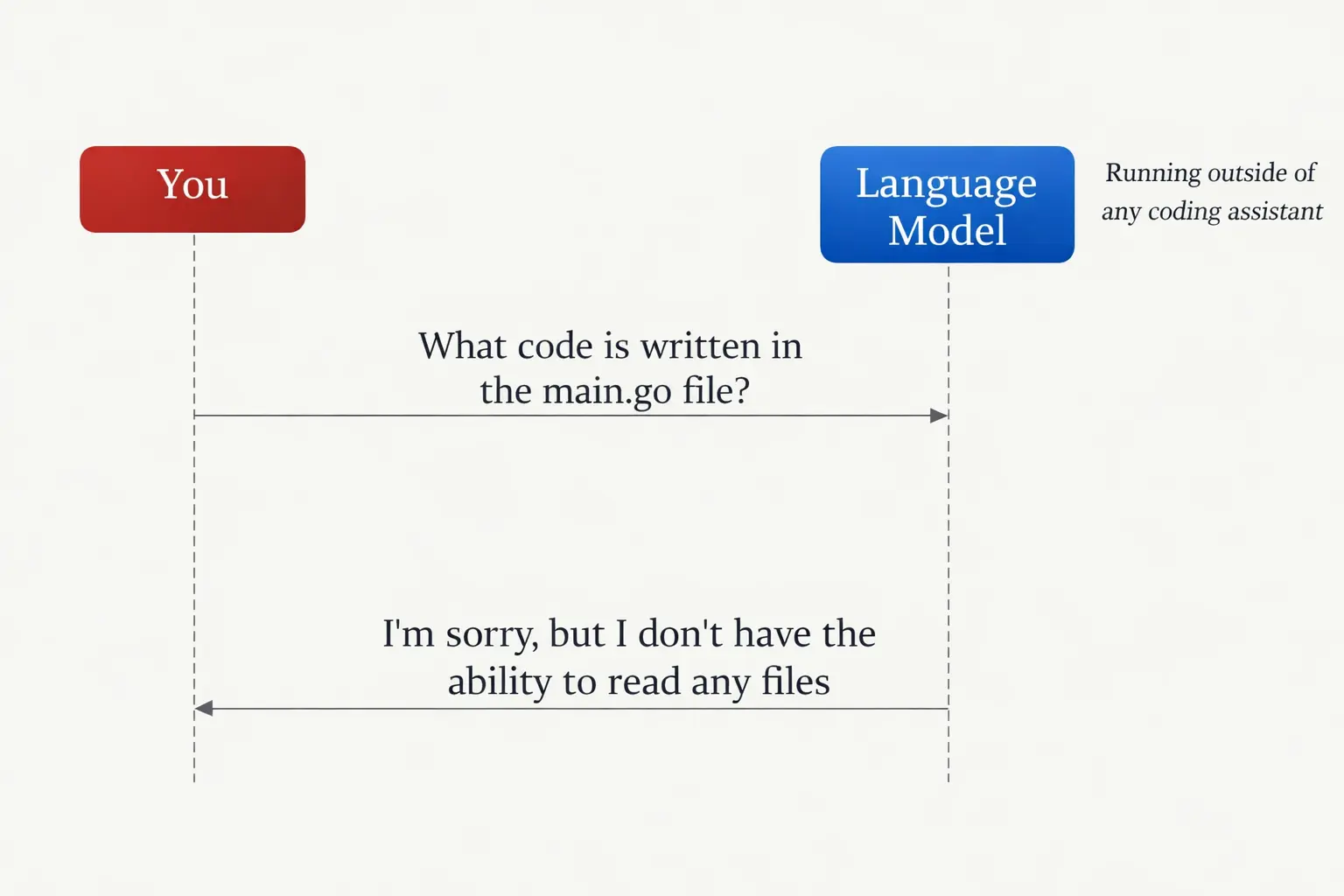
If you directly query a Language Model and ask, What code is written in main.go?, it will fail because the model does not have access to local files. A language model only takes text as input and generates text as output.
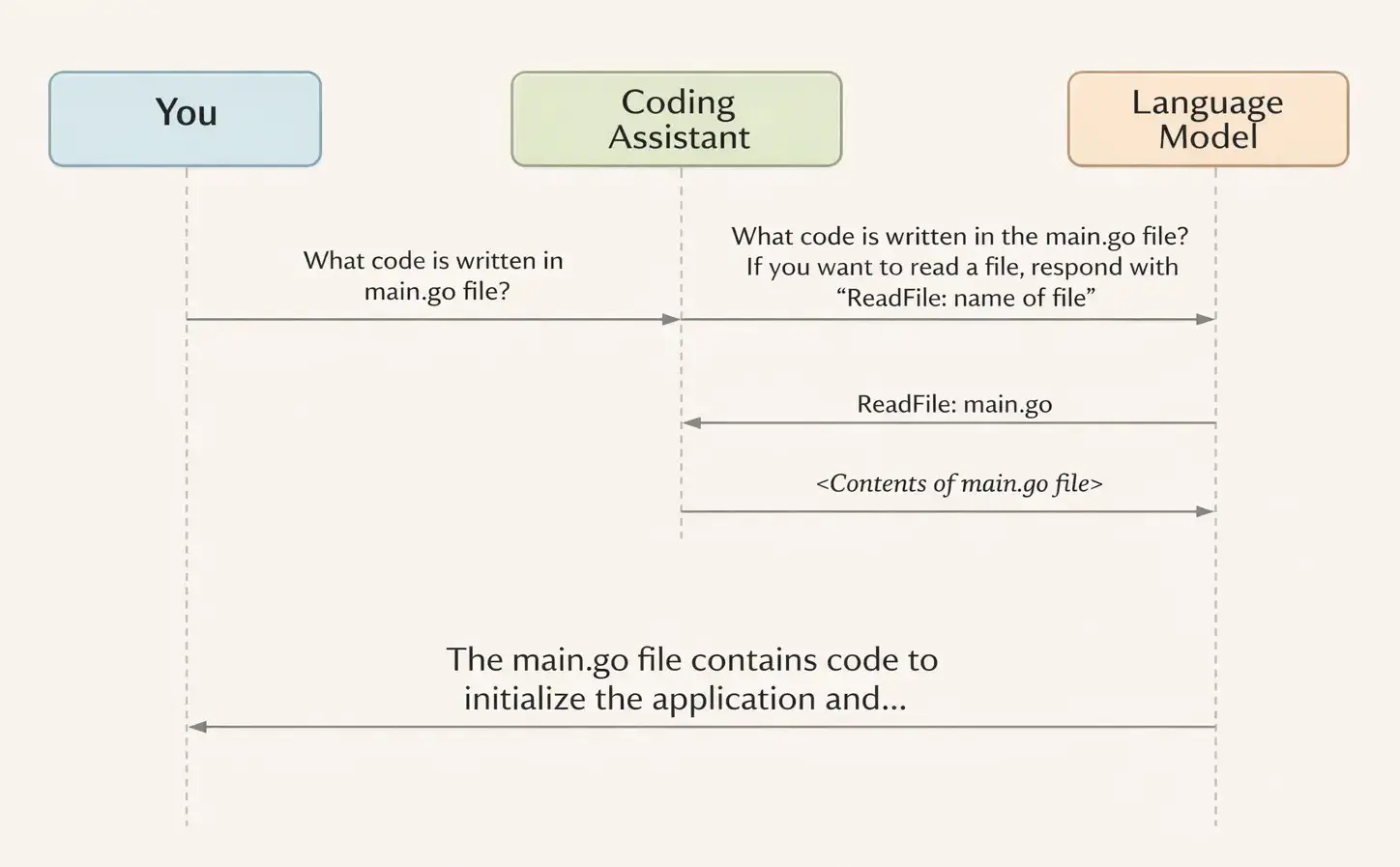
To solve this, Coding Assistant is used between the user and the Language Model. When the user sends a query, the Coding Assistant formats it and forwards it to the Language Model. If the model needs to read or write a file, it responds with a structured instruction (for example: “ReadFile: main.go”). The Coding Assistant then performs that action (like reading the file) and sends the file contents back to the model. This process may repeat multiple times until the model has enough information to generate the final answer. The final response is then returned to the user
The Evolution: From "Dumb" Autocomplete to "Smart" Agents
Coding assistance has transitioned from simple text matching to deep logical reasoning.
The Early Days (IntelliSense): In the late 90s, tools changed the game by suggesting variable names based on static analysis. It knew what existed, but not how to use it.
The Language Model Limit: A standard language model, when asked "What code is written in main.go?", will often apologize because it has no inherent ability to read your local files.
The Assistant Era: Modern assistants bridge this gap. They receive your question, instruct the model to use a "ReadFile" tool and then present the actual contents of your file to the model so it can provide an accurate answer.
Real-World Examples of AI Coding Tools
GitHub Copilot
The pioneer that popularized “ghost text” completions. Provides real-time inline suggestions directly inside your IDE. It understands surrounding context and helps with boilerplate, functions, tests and even documentation, significantly speeding up development workflows.
Cursor
An AI-native code editor built around deep assistant integration. Unlike traditional autocomplete tools, Cursor treats the assistant as a first-class collaborator. It can analyze entire codebases, edit multiple files, refactor logic and execute structured tool-based actions.
Claude Code
A coding assistant powered by the Claude model family from Anthropic. Excels at long-context reasoning, understanding complex instructions and navigating large repositories. Particularly strong in multi-step tool usage and structured problem-solving.
Amazon CodeWhisperer
Designed for cloud-first and AWS-heavy development environments. Provides intelligent code recommendations with a focus on security scanning, AWS SDK integration and enterprise workflows.
Gemini
Google's multimodal AI model integrated deeply across its developer ecosystem. Developed by Google, Gemini powers AI features inside Google products and coding tools. It supports code generation, debugging, explanation and large-context reasoning.
Benefits Across the Experience Spectrum
Experience Level
Primary Benefit
Beginner
Learning Accelerator: Explains what an error like "Cannot read property 'records' of undefined" actually means in simple terms.
Intermediate
Boilerplate Buster: Uses tools to read and write files automatically, saving hours of manual typing.
Advanced
Architectural Partner: Formulates complex plans to refactor entire modules by gathering deep project context.
Limitations and Risks
While modern coding assistants are extraordinarily powerful, they are not infallible. Understanding their limitations is essential for using them responsibly and effectively.
1. Context Requirements: Coding assistants depend entirely on accurate and sufficient context. If an assistant cannot properly “Gather Context” such as identifying relevant files, dependencies, configurations or log. Its “Formulate a Plan” step will likely fail. Incomplete context often leads to incorrect assumptions, shallow fixes or confident but inaccurate suggestions.
2. Security: Modern assistants can read and write files, execute commands and make network requests. These capabilities introduce real security considerations. You must ensure that any tool usage especially file modifications, shell execution or API calls is authorized, sandboxed and secure. Improper safeguards can lead to data leaks, insecure code patterns or unintended system changes.
3. Model Dependency:
The quality of assistance is directly tied to the strength of the underlying language model. Stronger models provide better reasoning, cleaner abstractions and more reliable multi-step planning. Weaker models may hallucinate functions, misinterpret APIs or overlook edge cases. The interface may look the same, but the model behind it determines the outcome.
4. Hallucinations: Language models generate probabilistic outputs, not verified facts. They may confidently produce incorrect implementations, outdated patterns or fabricated explanations. Human review and validation remain essential.
5. Over-Reliance: Excessive dependence on coding assistants can weaken debugging skills, architectural thinking and foundational understanding. These tools are meant to accelerate development not replace engineering judgment.
How to Use a Coding Assistant Effectively
Using a coding assistant well is less about typing prompts and more about giving structured direction, supervising execution and validating results.
1. Define Clear Tasks: Be specific and actionable. Instead of saying, “This doesn’t work,” provide the exact error message, relevant file names and expected behavior. Clear instructions improve the assistant’s ability to gather the right context and formulate an accurate plan.
2. Provide Relevant Context Upfront: If you already know which files, functions or constraints matter, include them. Supplying targeted context reduces unnecessary iteration and prevents the assistant from making incorrect assumptions about your codebase.
3. Monitor the Iteration: Pay attention to how the assistant gathers context and takes actions. If it starts reading irrelevant files, modifying unintended sections or overcomplicating the solution, intervene early and redirect it. Supervision improves output quality.
4. Leverage Model Strengths: Different models excel at different tasks. For example, models from Anthropic (the Claude series) are known for strong multi-step reasoning and structured tool use. Choose the right model for tasks like large refactors, file manipulation or complex debugging.
5. Break Down Complex Problems: For large architectural changes, guide the assistant step by step. First analyze, then plan, then implement. Structured collaboration produces more reliable results than asking for a full rewrite in a single prompt.
6. Review the Output Carefully: Never blindly accept changes. Always verify generated code, especially modifications involving authentication, data access, concurrency or infrastructure. The assistant can accelerate implementation but you remain responsible for correctness.
7. Use It as a Thinking Partner, Not Just a Generator: Ask the assistant to explain trade-offs, suggest alternative approaches or outline risks before implementation. This turns it from a code generator into an architectural collaborator.
Conclusion: Your New Secret Weapon
A coding assistant is no longer just a smarter autocomplete engine. It is an intelligent system that understands context, formulates structured plans and uses tools to execute them in a controlled, iterative loop. This shift marks a fundamental evolution in how software is built. We are moving from manual implementation toward AI-augmented engineering where reasoning, execution and refinement happen in collaboration between human and model.
By embracing AI coding tools, you free your mind from repetitive syntax, boilerplate scaffolding and mechanical debugging. That cognitive space can now be redirected toward higher-order thinking:
System design
Architectural decisions
Performance optimization
Scalability planning
Product innovation
The true advantage is not writing code faster. It is thinking better while the machine handles execution. Coding assistants are not replacing engineers. They are amplifying them. and the developers who learn to orchestrate this human-AI loop effectively will define the next generation of software engineering.
When I started programming professionally, writing code meant constant context switching. You wrote something, hit an error, searched documentation, opened five browser tabs, read Stack Overflow threads, came back, tried again.
\n
Today, you can write a comment like:
\n
// create a debounce function in JavaScript\n
\n
And within seconds, working code appears.
\n
That shift is not just convenience. It represents a fundamental change in how software is built. This new companion is called a coding assistant and it's quietly becoming one of the most important tools in a developer’s workflow.
\n
In this guide, we’ll walk from beginner understanding to advanced technical depth. By the end, you’ll not only know what a coding assistant is, you’ll know how to use it effectively and responsibly.
\n
What is a Coding Assistant?
\n
At its simplest, a coding assistant is a software tool designed to help developers write, debug and optimize code more efficiently. It acts as an intermediary between the user and a powerful Language Model.
\n
At a basic level, it predicts what you might type next. At an advanced level, it can generate entire functions, refactor code, write test cases, explain complex logic and even help with architectural decisions.
\n
Unlike a raw language model (A language model (LM) is an AI system that learns how human language works so it can understand, generate and predict text.) running on its own which often lacks the ability to read your local files or interact with your system, a coding assistant is equipped with the \"hooks\" necessary to understand your specific environment. While you are the captain steering the ship, the assistant handles the manual labor: gathering context, suggesting routes and even spotting technical leaks before they become critical errors.
\n
Modern coding assistants are often referred to as:
\n
\n
AI coding tools
\n
AI programming assistants
\n
AI code generation systems
\n
\n
But underneath all those labels, the core idea is simple: It’s a system that understands programming context and helps you think and build faster.
\n
If you directly query a Language Model and ask, What code is written in main.go?, it will fail because the model does not have access to local files. A language model only takes text as input and generates text as output.
\n
\n
To solve this, Coding Assistant is used between the user and the Language Model. When the user sends a query, the Coding Assistant formats it and forwards it to the Language Model. If the model needs to read or write a file, it responds with a structured instruction (for example: “ReadFile: main.go”). The Coding Assistant then performs that action (like reading the file) and sends the file contents back to the model. This process may repeat multiple times until the model has enough information to generate the final answer. The final response is then returned to the user
\n
\n
The Evolution: From \"Dumb\" Autocomplete to \"Smart\" Agents
\n
Coding assistance has transitioned from simple text matching to deep logical reasoning.
\n
\n
\n
The Early Days (IntelliSense): In the late 90s, tools changed the game by suggesting variable names based on static analysis. It knew what existed, but not how to use it.
\n
\n
\n
The Language Model Limit: A standard language model, when asked \"What code is written in main.go?\", will often apologize because it has no inherent ability to read your local files.
\n
\n
\n
The Assistant Era: Modern assistants bridge this gap. They receive your question, instruct the model to use a \"ReadFile\" tool and then present the actual contents of your file to the model so it can provide an accurate answer.
\n
\n
\n
Real-World Examples of AI Coding Tools
\n
GitHub Copilot
\n
The pioneer that popularized “ghost text” completions. Provides real-time inline suggestions directly inside your IDE. It understands surrounding context and helps with boilerplate, functions, tests and even documentation, significantly speeding up development workflows.
\n
Cursor
\n
An AI-native code editor built around deep assistant integration. Unlike traditional autocomplete tools, Cursor treats the assistant as a first-class collaborator. It can analyze entire codebases, edit multiple files, refactor logic and execute structured tool-based actions.
\n
Claude Code
\n
A coding assistant powered by the Claude model family from Anthropic. Excels at long-context reasoning, understanding complex instructions and navigating large repositories. Particularly strong in multi-step tool usage and structured problem-solving.
\n
Amazon CodeWhisperer
\n
Designed for cloud-first and AWS-heavy development environments. Provides intelligent code recommendations with a focus on security scanning, AWS SDK integration and enterprise workflows.
\n
Gemini
\n
Google's multimodal AI model integrated deeply across its developer ecosystem. Developed by Google, Gemini powers AI features inside Google products and coding tools. It supports code generation, debugging, explanation and large-context reasoning.
\n
Benefits Across the Experience Spectrum
\n
\n\n
\n
Experience Level
\n
Primary Benefit
\n
\n\n\n
\n
Beginner
\n
Learning Accelerator: Explains what an error like \"Cannot read property 'records' of undefined\" actually means in simple terms.
\n
\n
\n
Intermediate
\n
Boilerplate Buster: Uses tools to read and write files automatically, saving hours of manual typing.
\n
\n
\n
Advanced
\n
Architectural Partner: Formulates complex plans to refactor entire modules by gathering deep project context.
\n
\n\n
\n
Limitations and Risks
\n
While modern coding assistants are extraordinarily powerful, they are not infallible. Understanding their limitations is essential for using them responsibly and effectively.
\n
1. Context Requirements: Coding assistants depend entirely on accurate and sufficient context. If an assistant cannot properly “Gather Context” such as identifying relevant files, dependencies, configurations or log. Its “Formulate a Plan” step will likely fail. Incomplete context often leads to incorrect assumptions, shallow fixes or confident but inaccurate suggestions.
\n
2. Security: Modern assistants can read and write files, execute commands and make network requests. These capabilities introduce real security considerations. You must ensure that any tool usage especially file modifications, shell execution or API calls is authorized, sandboxed and secure. Improper safeguards can lead to data leaks, insecure code patterns or unintended system changes.
\n
3. Model Dependency: \nThe quality of assistance is directly tied to the strength of the underlying language model. Stronger models provide better reasoning, cleaner abstractions and more reliable multi-step planning. Weaker models may hallucinate functions, misinterpret APIs or overlook edge cases. The interface may look the same, but the model behind it determines the outcome.
\n
4. Hallucinations: Language models generate probabilistic outputs, not verified facts. They may confidently produce incorrect implementations, outdated patterns or fabricated explanations. Human review and validation remain essential.
\n
5. Over-Reliance: Excessive dependence on coding assistants can weaken debugging skills, architectural thinking and foundational understanding. These tools are meant to accelerate development not replace engineering judgment.
\n
How to Use a Coding Assistant Effectively
\n
Using a coding assistant well is less about typing prompts and more about giving structured direction, supervising execution and validating results.
\n
1. Define Clear Tasks: Be specific and actionable. Instead of saying, “This doesn’t work,” provide the exact error message, relevant file names and expected behavior. Clear instructions improve the assistant’s ability to gather the right context and formulate an accurate plan.
\n
2. Provide Relevant Context Upfront: If you already know which files, functions or constraints matter, include them. Supplying targeted context reduces unnecessary iteration and prevents the assistant from making incorrect assumptions about your codebase.
\n
3. Monitor the Iteration: Pay attention to how the assistant gathers context and takes actions. If it starts reading irrelevant files, modifying unintended sections or overcomplicating the solution, intervene early and redirect it. Supervision improves output quality.
\n
4. Leverage Model Strengths: Different models excel at different tasks. For example, models from Anthropic (the Claude series) are known for strong multi-step reasoning and structured tool use. Choose the right model for tasks like large refactors, file manipulation or complex debugging.
\n
5. Break Down Complex Problems: For large architectural changes, guide the assistant step by step. First analyze, then plan, then implement. Structured collaboration produces more reliable results than asking for a full rewrite in a single prompt.
\n
6. Review the Output Carefully: Never blindly accept changes. Always verify generated code, especially modifications involving authentication, data access, concurrency or infrastructure. The assistant can accelerate implementation but you remain responsible for correctness.
\n
7. Use It as a Thinking Partner, Not Just a Generator: Ask the assistant to explain trade-offs, suggest alternative approaches or outline risks before implementation. This turns it from a code generator into an architectural collaborator.
\n
Conclusion: Your New Secret Weapon
\n
A coding assistant is no longer just a smarter autocomplete engine. It is an intelligent system that understands context, formulates structured plans and uses tools to execute them in a controlled, iterative loop. This shift marks a fundamental evolution in how software is built. We are moving from manual implementation toward AI-augmented engineering where reasoning, execution and refinement happen in collaboration between human and model.
\n
By embracing AI coding tools, you free your mind from repetitive syntax, boilerplate scaffolding and mechanical debugging. That cognitive space can now be redirected toward higher-order thinking:
\n
\n
System design
\n
Architectural decisions
\n
Performance optimization
\n
Scalability planning
\n
Product innovation
\n
\n
The true advantage is not writing code faster. It is thinking better while the machine handles execution. Coding assistants are not replacing engineers. They are amplifying them. and the developers who learn to orchestrate this human-AI loop effectively will define the next generation of software engineering.
","categoryId":306,"subCategoryId":306,"contentFormat":5,"blogId":43,"userId":"MjlfNF84LVs0NV0ybi10Q19BTmdlX19JdA==","title":"What Is a Coding Assistant? A Complete Guide for Modern Developers","url":"what-is-a-coding-assistant","bannerImage":"","seoDescription":"","generatedOn":"2026-03-03T18:49:30","updatedOn":"2026-03-03T18:49:30"},"popularContents":[{"id":168,"title":"Amazon SDE-2 Interview Experience (3 Years Experience)","url":"amazon-sde-2-interview-experience-3-years-experience","description":null,"seoDescription":" Read a real Amazon SDE-2 interview experience covering the online assessment, coding rounds, object-oriented design, leadership principles and system design.","contentType":5,"generatedOn":"2026-10-14T23:22:15.9587204Z","viewCount":0},{"id":34,"title":"System Design Deep Dive: 25 Essential Interview Questions","url":"system-design-deep-dive-25-essential-interview-questions","description":null,"seoDescription":"","contentType":5,"generatedOn":"2026-10-14T23:22:15.9587121Z","viewCount":0},{"id":166,"title":"System Design Interview – BIGGEST Mistakes to Avoid","url":"system-design-interview-biggest-mistakes-to-avoid","description":null,"seoDescription":"Learn the biggest mistakes to avoid in a system design interview, from unclear requirements to poor trade-off analysis. Includes real-world cases, advanced insights and examples to help you ace your next system design interview.","contentType":2,"generatedOn":"2026-10-14T23:22:15.9539706Z","viewCount":0},{"id":173,"title":"Uber SDE-2 Interview Experience : LLD, HLD, DSA & Hiring Manager Round","url":"uber-sde-2-interview-experience-lld-hld-dsa-hiring-manager-round","description":null,"seoDescription":"Read a real Uber SDE-2 interview experience covering DSA, low-level design, high-level system design, behavioral rounds, hiring freeze and key takeaways.","contentType":5,"generatedOn":"2026-10-14T23:22:15.9587236Z","viewCount":0},{"id":83,"title":"Uber SDE 2 Interview Experience (5 Rounds, Selected) - Complete DSA Questions with solution, System Design & Managerial Round","url":"uber-sde-2-interview-experience","description":null,"seoDescription":"Uber SDE 2 interview experience with 5 rounds, real DSA questions, system design, coding round, and preparation tips to crack Uber interviews.","contentType":5,"generatedOn":"2026-10-14T23:22:15.9587158Z","viewCount":0},{"id":165,"title":"Top 50+ SQL Interview Questions and Answers for Intermediate to Advanced","url":"top-sql-interview-questions-and-answers-for-intermediate-to-advanced","description":null,"seoDescription":"Top SQL Interview Questions and Answers for Intermediate to Advanced. Top SQL Interview Questions for experience. Frequently asked SQL interview questions with answers","contentType":2,"generatedOn":"2026-10-14T23:22:15.953964Z","viewCount":0},{"id":130,"title":"Rippling SDE-2 Interview Experience (4+ Years Experience) | Offer Received | Coding, LLD & System Design","url":"rippling-sde-2-interview-experience-4-years-experience-offer-received-coding-lld-system-design","description":null,"seoDescription":"Detailed Rippling SDE-2 interview experience with complete 5 rounds, coding questions, rules engine design, system design and preparation tips.","contentType":5,"generatedOn":"2026-10-14T23:22:15.9587175Z","viewCount":0},{"id":197,"title":"My Adobe SDE Interview Experience (Aug 2026) 5 Rounds, Selected","url":"my-adobe-sde-interview-experience-aug-2026-5-rounds-selected","description":null,"seoDescription":"Real Adobe SDE interview: 5 rounds, 4 DSA problems (Rotate Array, BSTs, Kth Smallest Matrix), code review & behavioral round. Full solutions + tips.","contentType":5,"generatedOn":"2026-10-14T23:22:15.9587248Z","viewCount":0},{"id":138,"title":"DSA Patterns for Coding Interviews: Complete LeetCode Roadmap (Beginner to Advanced)","url":"dsa-patterns-for-coding-interviews-complete-leetcode-roadmap-beginner-to-advanced","description":null,"seoDescription":"Master every LeetCode pattern for coding interviews. Learn Arrays, Sliding Window, Graphs, Dynamic Programming, Trees, Heaps and more with 250+ curated problem","contentType":5,"generatedOn":"2026-10-14T23:22:15.958719Z","viewCount":0},{"id":172,"title":"Google L4 Software Engineer III interview experience | Selected","url":"google-l4-software-engineer-iii-interview-experience-selected","description":null,"seoDescription":"Google L4 Software Engineer III interview experience with API design, Googlyness, route matching, graph coding rounds, follow-up questions and tips.","contentType":5,"generatedOn":"2026-10-14T23:22:15.9587221Z","viewCount":0}],"latestContents":[{"id":219,"title":"6 Tools That Made My Life Easier as a Software Engineer","url":"6-tools-that-made-my-life-easier-as-a-software-engineer","description":null,"seoDescription":"The 6 developer tools I use daily as a software engineer: Git, VS Code, Docker, Postman, Chrome DevTools, and AI assistants, with real tips, mistakes, and trade","contentType":5,"generatedOn":"2026-10-14T23:22:15.9502555Z","viewCount":0},{"id":218,"title":"When Should a Business Use Multiple AI Agents Instead of One?","url":"when-should-a-business-use-multiple-ai-agents-instead-of-one","description":null,"seoDescription":"Single agent or multi-agent AI? Learn the 4 signals that justify splitting agents by knowledge, permissions, and risk, plus routing and handoff tips.","contentType":5,"generatedOn":"2026-10-14T23:22:15.9502606Z","viewCount":0},{"id":216,"title":"AI in Clinical Trials Market Estimated to Experience a Hike in Growth by 2035","url":"ai-in-clinical-trials-market-estimated-to-experience-a-hike-in-growth-by-2035","description":null,"seoDescription":"The exclusive information about market dynamics serves as a valuable guide to predict economic scenarios and initiatives taken to enhance future growth. Our mar","contentType":5,"generatedOn":"2026-10-14T23:22:15.9502622Z","viewCount":0},{"id":217,"title":"AI in Clinical Trials Market Estimated to Experience a Hike in Growth by 2035","url":"ai-in-clinical-trials-market-estimated-to-experience-a-hike-in-growth-by-2035","description":null,"seoDescription":"The exclusive information about market dynamics serves as a valuable guide to predict economic scenarios and initiatives taken to enhance future growth. Our mar","contentType":5,"generatedOn":"2026-10-14T23:22:15.9502638Z","viewCount":0},{"id":215,"title":"What Happens When an AI Agent Doesn't Know the Answer?","url":"what-happens-when-an-ai-agent-doesnt-know-the-answer","description":null,"seoDescription":"Most AI agents fail quietly. They guess instead of saying \"I don't know.\" Here's how to design better fallback and human-handoff behavior.","contentType":5,"generatedOn":"2026-10-14T23:22:15.9502651Z","viewCount":0},{"id":214,"title":"Greedy Algorithms Explained: How They Work, When They Fail and How to Use Them","url":"greedy-algorithms-explained-how-they-work-when-they-fail-and-how-to-use-them","description":null,"seoDescription":"Learn greedy algorithms step by step with C# code Dijkstra, Huffman coding, knapsack and MSTs plus when greedy fails and how to prove it's correct","contentType":5,"generatedOn":"2026-10-14T23:22:15.9502669Z","viewCount":0},{"id":213,"title":"Amazon SDE II Interview Experience (Bangalore, Selected) ~ Aug 2026","url":"amazon-sde-ii-interview-experience-bangalore-selected-aug-2026","description":null,"seoDescription":"Amazon SDE II interview experience from Bangalore covering 4 rounds, DSA, LLD, system design, Leadership Principles, coding questions and selection.","contentType":5,"generatedOn":"2026-10-14T23:22:15.950271Z","viewCount":0},{"id":212,"title":"How to Get 10x Better AI Answers Without Writing Better Prompts : 10 Proven Techniques","url":"how-to-get-10x-better-ai-answers-without-writing-better-prompts-10-proven-techniques","description":null,"seoDescription":"Get better AI answers without complex prompts. Learn 10 practical techniques using context, examples, tools, feedback, and verification.","contentType":5,"generatedOn":"2026-10-14T23:22:15.9502727Z","viewCount":0},{"id":211,"title":"I Interviewed for a Microsoft SDE I Role. Here's Everything That Happened.","url":"i-interviewed-for-a-microsoft-sde-i-role-heres-everything-that-happened","description":null,"seoDescription":"My real Microsoft SDE I interview experience, all 4 rounds, the exact DSA problems with fully tested solutions, the WhatsApp system design round","contentType":5,"generatedOn":"2026-10-14T23:22:15.9502741Z","viewCount":0},{"id":140,"title":"PolicyBazaar Software Development Engineer (SDE) Interview Experience | DSA, Core CS & System Design","url":"policybazaar-software-development-engineer-sde-interview-experience-dsa-core-cs-system-design","description":null,"seoDescription":"Detailed PolicyBazaar SDE interview experience covering 3 rounds: DSA coding, core CS assessment and system design with key learnings and insights.","contentType":5,"generatedOn":"2026-10-14T23:22:15.9502759Z","viewCount":0}],"relatedContents":[{"id":182,"title":"Harness Engineering Explained: What It Is, Why It Matters and How It Works (With Real Examples)","url":"harness-engineering-explained-what-it-is-why-it-matters-and-how-it-works-with-real-examples","description":null,"seoDescription":"Harness Engineering Explained: Complete Guide with Examples, Architecture & Interview Questions (2026)","contentType":5,"generatedOn":"2026-10-14T23:22:15.9659691Z","viewCount":0},{"id":75,"title":"AI Productivity Trends 2026: What Experts Reveal","url":"ai-productivity-trends-2026-what-experts-reveal","description":null,"seoDescription":"Explore AI productivity trends 2026, including AI agents, automation, and workplace shifts shaping the future of AI productivity and work efficiency.","contentType":5,"generatedOn":"2026-10-14T23:22:15.9659729Z","viewCount":0},{"id":74,"title":"Best AI Tools for Productivity in 2026","url":"best-ai-tools-for-productivity-in-2026","description":null,"seoDescription":"Best AI tools for productivity in 2026. Discover top AI apps to save time, automate work, and boost efficiency with smart AI productivity tools.","contentType":5,"generatedOn":"2026-10-14T23:22:15.9659745Z","viewCount":0},{"id":58,"title":"Impact of AI on Software Developers: Are Developer Jobs Safe in the Future?","url":"impact-of-ai-on-software-developers-are-developer-jobs-safe-in-the-future","description":null,"seoDescription":"Will AI replace programmers? Learn how AI coding tools are reshaping software development and what developers must do to stay relevant.","contentType":5,"generatedOn":"2026-10-14T23:22:15.9659758Z","viewCount":0},{"id":44,"title":"Top 12 AI Skills to Learn in 2026: The Ultimate Career Roadmap","url":"top-12-ai-skills-to-learn-in-2026-the-ultimate-career-roadmap","description":null,"seoDescription":"Master the top 12 AI skills in 2026 to future-proof your career. From Agentic AI to MLOps, discover the essential technical and strategic skills for the AI era.","contentType":5,"generatedOn":"2026-10-14T23:22:15.9659771Z","viewCount":0},{"id":39,"title":"Top 10 AI Coding Tools Every Developer Should Learn in 2026","url":"top-10-ai-coding-tools-every-developer-should-learn-in-2026","description":null,"seoDescription":"","contentType":5,"generatedOn":"2026-10-14T23:22:15.9659821Z","viewCount":0},{"id":153,"title":"Agentic AI : The Rise of Autonomous Digital Agents How They Work, Why They Matter and What’s Next","url":"agentic-ai-the-rise-of-autonomous-digital-agents-how-they-work-why-they-matter-and-whats-next","description":null,"seoDescription":"Explore how Agentic AI autonomous AI systems powered by LLMs and reinforcement learning. Agentic AI The Rise of Autonomous Digital Agents How They Work Why They Matter and What’s Next","contentType":2,"generatedOn":"2026-10-14T23:22:15.9659833Z","viewCount":0}]}}},"source":{"isMobile":false}};
window.__CLIENT_RENDER__ = false;





 \n
\n 
